
A single or a pair?
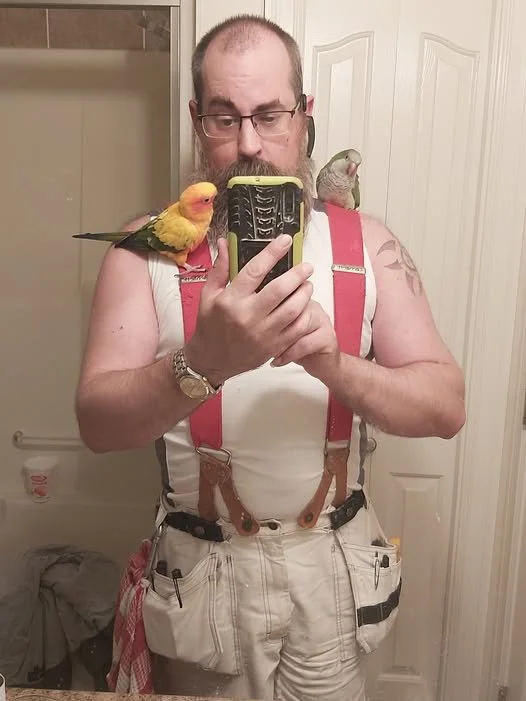
And an older picture of me with my bonded pair of Beth and Levant. They are still with me, but look at how much hair I have here! And its all still brown!
One bird or two? Will my birdie be lonely alone? Will a pair still be friendly with me? Would my birdie like a friend?
These are questions I am asked on a daily basis, and the short answer is maybe, depending on your situation, depending on your bridie, and depending on your relationship. Some birds require another bird for companionship to be happy, some would benefit, some do just fine just being bonded with their human. I will go into more detail on each type of bird I breed here, These are the birds I have experience in, have raised and trained and watched grow over the years, observing their behaviors on a daily basis. Just take into consideration that this is based on my experiences, and individual results may vary!
And as for a pair not being friendly, the quaker pictured here, Sister Mary Elizabeth, Beth for short, is my cuddliest and friendliest birdie. She is also bonded with Levant, the Sun Conure. Levant was parent raised, is not tame at all and cannot be handled alone, but sticks to me like glue along with my quaker. They are on me for hours each day, with Beth playing with my ears and eyeglasses, preening my beard and mimicking all the household sounds and talking into my ear as I do my daily feedings and cleanings. A pair will be just as friendly and bonded to you as a single, with the added benefit of being a happier and more confident and well adjusted individual. It all comes down to the time you spend together, shared joy is not diminished, it is multiplied.
As for the individual types of birdies....
Lineoated parakeets, and other parakeets such as red rumps, barnards, rosellas, many-colored and such really do need another same breed bird as a companion. They do not form as close or personal a bond with humans as other breeds, are more reserved and become withdrawn and timid when alone. Their flocking drive is very high, and they need companionship to feel secure and safe. They will survive alone, but will not thrive as they should. I usually give discounts on pairs of these birds because of this, and also give discounts when there is only one baby left here to find them a new home as quickly as possible. I will also give discounts to past customers who have a single and are looking for a companion.
Budgies! These birdies deserve their own post all by themselves! Budgies also have a very high flock drive, and do best in pairs and even better in groups. They are so much fun to watch play and to interact with in multiples, and easy to keep. They can do just fine as singles, but they will require somebody that is home all day, and a lot of out of cage interaction, play and exploration to feel safe and secure. I have actually never kept a single budgie, they have always been in pairs or groups, very large groups sometimes and I have never seen my birds fighting or not getting along. A single bird will need a human in sight to take their safety cues from, and a lonely bird will often end up being inactive for long periods, not playing or taking much interest in their surroundings. When out of cage with their human around they will explore their surroundings and take joy in sharing play, just as they would with a birdie companion.
Cockatiels also do better in pairs, as they are such sensitive birds and can show stress behaviors when lonely. They will do well as singles but require lots of daily interaction, riding around on shoulders and singing for their humans. As with all birds, they do best with a same breed companion, although for some reason they do well with a zebra finch, of all birds, as companions! Mixing breeds for companionship while out of cage can work in certain situations, they should not be caged together.
Finches and canaries: Finches must always be kept in pairs or more, they should not be handled and really suffer when kept alone. Canaries on the other hand do fine as singles, and are usually separated out of breeding season. They do like to observe your daily life though!
Lovebirds and parrotlets are similar in size but different in needs. Lovebirds should be in pairs, hence their name, they love each other so much! A single lovebird will bond very closely to a human, and will do well as a single as long as they get tons of interaction each day. They like to spend most of the day out of cage, and bond so closely with their human that jealousy can become a very real problem and can lead to bad behaviors such as biting and aggression to humans and other birds in their cages. Lovebirds have a habit of biting other birds toes very badly through cage bars, and can become very stubborn about getting things their way. I have always found pairs to be the most friendly, and have a pair bonded with me, liking to perch on my moving hands while I do my daily chores and buzzing around my head. Parrotlets on the other hand do better as singles than other small birds, as they have more of a big bird personality. As long as they get several hours a day of interaction they are happy, but like lovebirds can be very demanding of the attention they want!
Conures, quakers and ringnecks: These larger birds are naturally more confident, and can do just fine as singles. They will require lots of interaction each and every day, and love to ride around on a shoulder sharing your life with you. When kept as pairs one bird can bond more closely with you, while the other might bond more with their birdie companion. Whatever the case, where one goes the other will follow, and if one is following you so will the other. I have seen single birds become aggressive, and can bond closely with a person's face but become jealous of their hands, or vice versa. Birds often see a humans hands as a separate entity, a third party.
Cockatoos, amazons and macaws....These birds are not so much pets as they are a lifestyle choice. Single or in pairs, they require a huge amount of attention and interactions. My cockatoo needs to be tucked in every night, and a good session of intense cuddles every day to be happy. My amazon will scream every time I enter the room until I go over and give him scritches, and then proceed to tell me all about his day. I no longer breed these larger birds, there are just too many in rescues such as Greyhaven because of the amounts of attention they need to be happy. They are a lifetime commitment for sure, high investment high reward birds for sure!
There are several things you can do to make a single bird happier. I purchased a round dozen of those Alexa dot smart speakers the last time they went on sale, and have every bird room playing classical, zen or nature music all day, and chirping crickets all night to help my birds feel more secure. Having the TV on during the day helps as well, and having birds of different breeds in the same room helps with loneliness, they like hearing and seeing other birds in their environment.
In conclusion, most birds are happy as singles as long as there is someone home all day, and they get lots of attention and out of cage interaction each and every day. But having a second bird in the cage is just a fraction more work and cost to keep as a single, but more than double the fun. But if you work all day, or life get busy, your birdie having a companion will keep them happy and healthy and a joy to have around. I have known people with dogs that keep them locked in a kennel all day while they are at work, and then wonder why they misbehave and bark and destroy the couch. Birds are much the same way, they get lonely just like we do.