
Deficiencies and supplementation
Sunlight and Supplements, Vitamin D and Deficiencies!
We all want what is best for our birds, yet most pet birds are deficient in Vitamins A and D, Iodine and Calcium. Commercial seed mixes just do not have these vitamins and minerals, and many birds do not eat enough pellets willingly to make up the deficiency. Putting your bird on an all-pellet diet is not the answer either, the monotony is very hard on birds and has been shown to cause serious liver and other health issues. I have had to help with several birds that almost starved to death when presented with an all pellet diet, and many more that developed strong behavioral problems. Yes, pellets are easy and currently popular, but are not enough alone and many consider an all pellet diet to be cruel. Pellet diets are highly recommended by many professionals, who all just happen to sell pellets under contract, and they are easy to stock and store. The best diet remains a balanced one, and I continue to feed all my birds seed, pellets and daily fresh chop with treats and supplements such as boiled egg yolk, millets and various fruits in moderation.
Lets start with the most common deficiency, Vitamin A! Most birds tested are deficient in Vitamin A, which can cause serious immune system problems. There is a very easy fix though, carrots! All my birds love carrots, they are high in Vitamin A, and are cheap and easy to serve chopped, grated, diced, shredded and even whole. Drop a whole carrot into my budgie cage and it is gone very fast, and the larger birds like to take big chunks in their feet and munch away. In fact, their daily vegetable chop is 20% carrot.
Another serious deficiency is Vitamin D, and without it birds cannot process the Calcium in their diets. In nature birds get Vitamin D from the same place we do, the Sun! They absorb sunlight through their eyes mostly, and the skin on their feet and process it into Vitamin D. Unfortunately many birds do not get enough access to sunlight. Putting their cages in front of a window gives only filtered light, and can put them in danger of overheating. I do use UVA/UVB lighting extensively, but it is expensive, difficult to set up properly and the bulbs must be replaced yearly. The birds love it though, and it does help, but is not as good as natural sunlight. Putting a bird cage outside in the sun can expose birds to various insects like mites, and the danger of overexposure. Vitamin D is also hard to supplement naturally, as it is usually only found in animal products and not veggies or fruits. Boiled egg yolk can be used, and birds love it, but cannot be given more than once a week or in large enough quantities for health reasons. Other sources include meat and fish, and even cod-liver oil and fish oil, but are hard to administer safely. For this I fall back on water soluble and powdered vitamin supplements. Do not use the cheap drops sold in big box pet stores, they are expensive and come with problems. I have tried them all, and either the birds do not drink the dosed water, or the organic ingredients in the cheaply made vitamins results in heavy and hard to remove bacteria growth in the water dishes. I use a product called Loford, purchased online, and many other brands of "real" supplements can be purchased online from places like Ladygouldian.com and AvesCanada.com. They can be pricey, but a little goes a long way and are much cheaper than vet bills!
The last deficiency is Calcium and Iodine. Iodine is required for proper thyroid functioning, and deficiencies can result in difficult moults, poor feather condition, breathing problems, inactivity and poor breeding. Calcium is very very important for bone health and in egg laying and egg laying recovery. When laying, birds will lose calcium from their bones to make their eggs, and without supplementation have a hard time building their reserves back up. This can lead to egg binding, which can be fatal, and a host of other problems. The solution is easy, cuttlebone, virtually made from calcium and with high iodine and is a natural product that birds love and also helps to keep their beaks trim. Again, do not get cuttlebone from big box stores. They are usually tiny and overpriced, or sold in blister packs at inflated prices after being stored for years. West Coast Tropical Bird studio and Just for Birds are great places for cuttlebone, as well as online or here when you pick up your birdie.
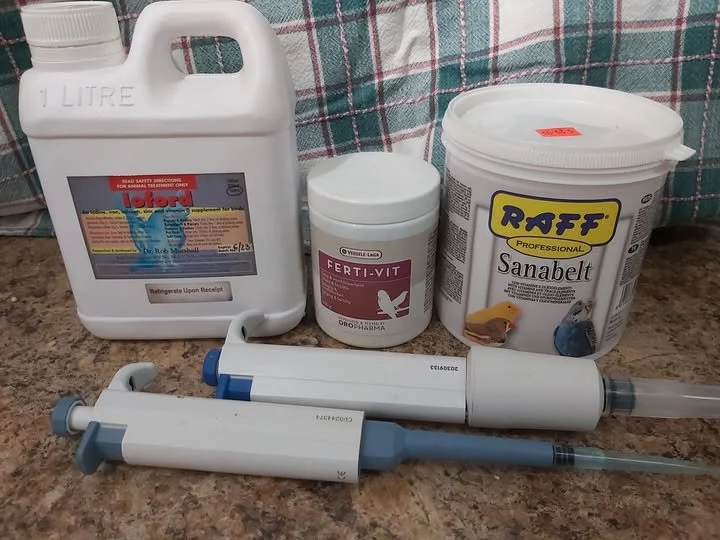
The items in the picture are my main supplementing tools. Loford liquid water soluble vitamin supplements used twice a week in the birds water, can be purchased online from the sites listed above. Ferti-Vit is a great powdered supplement I use for all my breeding birds in season, making egg laying easier and can be found on Amazon. Raff is a great powdered supplement sold at Just for Birds in Langley, and is a good all around vitamin and mineral supplement given 3x a week. Powdered supplements can be difficult to dose, you will have to follow the instructions carefully. I did a tonne of maths and put together a shaker with calculated openings that allow me to dispense one dose with each shake, and I give a certain amount of shakes on top of each bowl of chop depending on the number and size of the birds in each enclosure. On the bottom of the picture are the two lab quality automatic pipettes I use for the liquid supplements, not too expensive on Amazon and perfect for administering the correct amount of uL or "drops" to each water bowl without having to count out each individual drop.
Of course, these are just suggestions based on my experience with my flock, and have worked for me very well having been developed over the years with hundreds of hours of research and much trial and error. A good professional breeder will have no problem spending the extra money on good supplementation, a happy healthy birdie pair is much easier to work with and supplements are much cheaper than vet bills. And much cheaper than replacing a pair if they pass, both monetarily and emotionally. Birds fed on a seed only diet will survive, but not have the long and healthy life of a birdie with a healthy varied diet with careful supplementation.